Quick Search Guide
You can view digitised Soldiers’ Wills through the National Archives’ online catalogue.
To find a specific soldier, type their name into the search box. If a will exists, you’ll see an entry such as Connor, Harry: soldier’s will (Ref: E/160550/1). Open the entry and click the PDF link (for example ConnorH_E160550.pdf) to view the images.
To browse the entire collection, go to Advanced Search, enter E/* in the Reference Code field, and run the search. This returns all Soldiers’ Wills currently available.
You can also follow our step‑by‑step illustrated guide, which shows exactly how to search the Soldiers’ Wills in the online catalogue.
About the collection
The National Archives holds over 9,000 wills of Irish soldiers who died while serving in the British Army. Most date from the First World War, with a smaller number from the South African War (1899–1902) and the late 19th century.
After a soldier’s death, his will was recovered from his personal effects and sent to the War Office in London. From there it was forwarded to the Probate Office in Dublin, and later transferred to the National Archives. These wills were never entered in the annual probate calendars, so this collection is often the only surviving official record of a soldier’s final wishes.
All wills have been digitised and are available to view free online.
What the collection contains
World War I wills
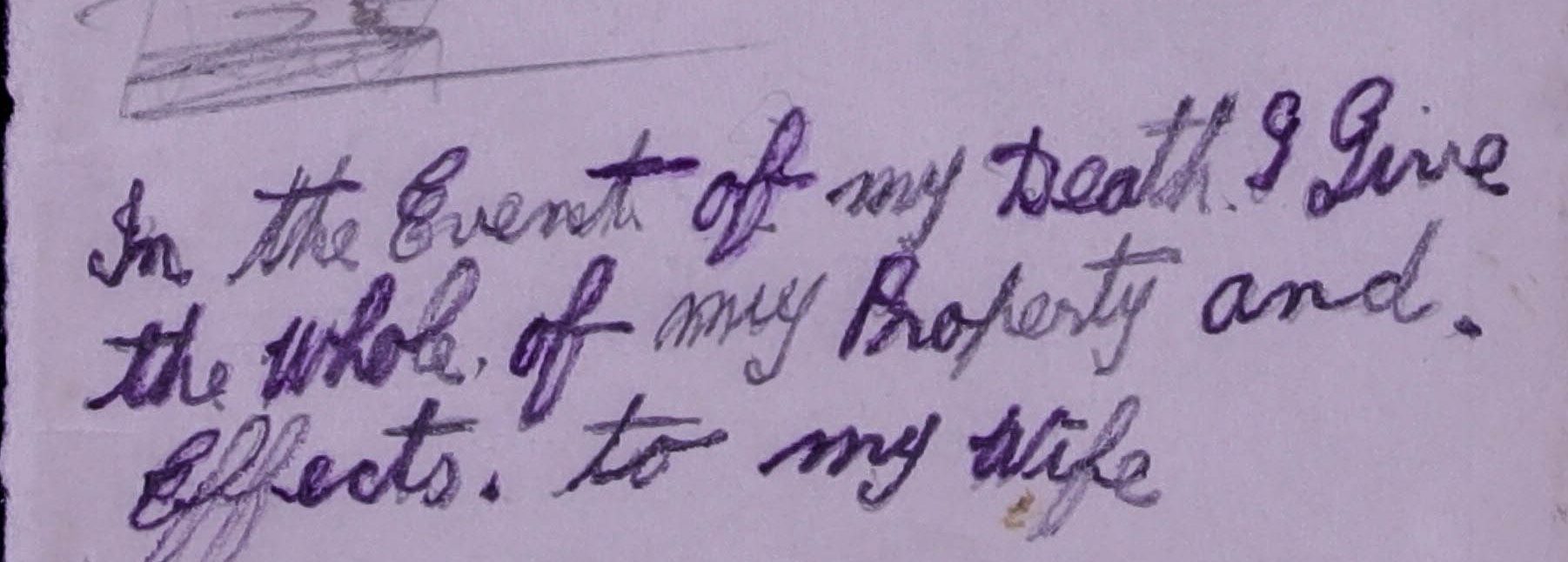
Most wills were written in the soldier’s pocket service book, known as “The Small Book”. This small booklet (14cm × 9cm) contained Army regulations, training records and pay information, and included a page titled “Will”. Soldiers wrote their wishes in their own words, guided by brief printed instructions.
The format of these wills changed over time. Early in the war, some soldiers wrote their wills on scraps of paper. As casualties increased in 1916, the Small Book page became the standard place to record a will. These entries are usually short and handwritten. Because many soldiers were young and unmarried, they often left their belongings to a parent, a brother or sister, or a close friend serving with them.
Many of these wills were not witnessed and are therefore classed as informal wills. The War Office validated them by attaching a short certificate confirming that the will had been found among the soldier’s effects. Later in the war, this certificate was printed directly on the envelope labelled “Informal Will”.
Formal wills and other formats
Alongside the Small Book entries, the Army also provided pre‑printed will forms. These required witnesses and recorded full personal details. Some were stamped in Army record offices before being forwarded to London.
In cases where no written will survived, the War Office sometimes accepted a nuncupative will — a statement of the soldier’s intentions based on information provided by family or beneficiaries.
A small number of soldiers wrote letters home that included clear instructions about their belongings. Where these intentions were unambiguous, the War Office accepted the letter as the soldier’s will.
Boer War wills (1899–1902)
The collection includes 29 wills from soldiers who died in the South African War. These are not form wills but letters written to mothers, girlfriends, brothers and other family members. They are often longer and more descriptive than the First World War wills, containing personal news, reflections on home life and vivid details of service in South Africa. They offer a different kind of insight into the lives of Irish soldiers overseas.
Why these wills matter
The Soldiers’ Wills are a unique record of the men who served and died, many of them very young. They reveal family relationships, social backgrounds and the personal impact of war on Irish households.
They also show how soldiers expressed their wishes in simple, direct language, often in the midst of active service. For many families, these wills were the only personal document returned after a soldier’s death.
How to search the collection
The Soldiers’ Wills can be accessed through the National Archives’ online catalogue.
To search for a particular soldier, enter their name in the search box. If a will exists, open the catalogue entry and click the PDF link to view the digitised images.
To browse the full collection, go to Advanced Search, type E/* in the Reference Code field, and run the search. This will display all Soldiers’ Wills currently available.
A step‑by‑step PDF with images is also available to assist with searching the collection.
Digitisation and conservation
Before digitisation, many wills required careful conservation. Some documents were fragile, and others had been stored in envelopes where the gummed flaps had stuck to the paper.
Conservators began by surface‑cleaning the wills with smoke sponges and removing staples or metal fastenings with a micro‑spatula. Sensitive inks were protected with small sheets of Mylar.
Where wills were stuck to their envelopes, conservators used a preservation pencil — a tool that produces a controlled jet of warm steam. This gently rehydrated the old glue, allowing the will to be lifted free without damaging the paper or the writing.
The War Office often attached certified notes to the back of wills, confirming where they had been found. When these obscured original text, conservators used a damp pack (layers of blotter and Mylar under a glass weight) to soften the adhesive. Once loosened, the note could be lifted away with a spatula and tweezers, and any remaining glue removed with dampened cotton swabs.
Related sources
Researchers may also find useful information in the 1901 and 1911 Census and the Commonwealth War Graves Commission.