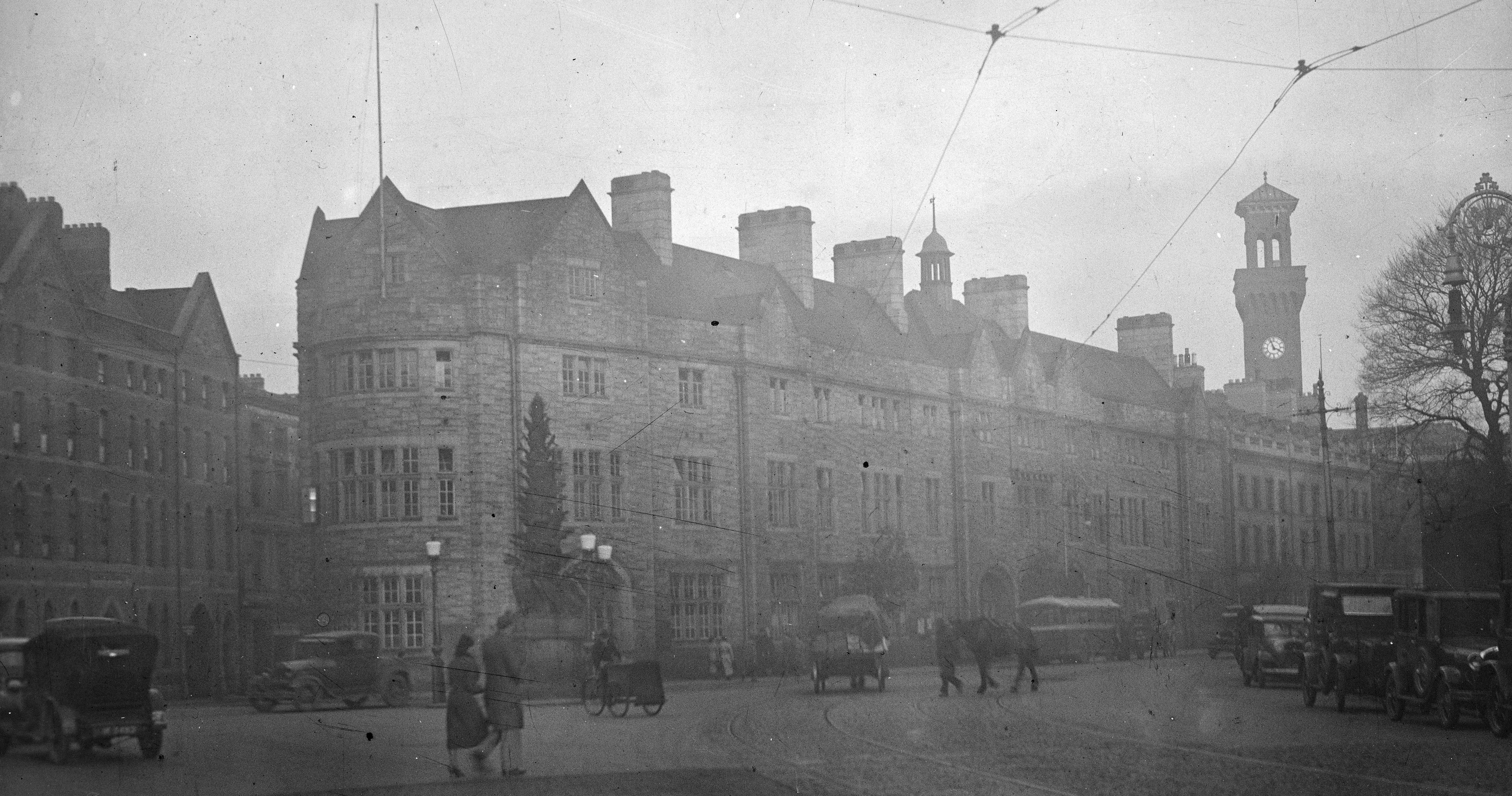

Pearse Street is in Dublin’s south inner city and runs on an east-west axis from College Street and D’Olier Street, along the northern edge of the campus of Trinity College Dublin, towards Grand Canal Dock and the old fishing village of Ringsend towards the mouth of the River Liffey. The street was laid out from the late eighteenth-century onwards; it was originally named Great Brunswick Street but following independence it was renamed Pearse Street after Patrick and William (‘Willie’) Pearse, both executed for their role in the Easter Rising of 1916.
The change was dictated by the fact that the Pearse family home where Patrick and William were born was at no. 27 on the street. Ten years after their executions one of the residents of no. 27 was John Dower, a pensioner who had declined to record his last employer, a detail that was filled in by the census enumerator: ‘British Army’. It is tempting to speculate why he didn’t mention the British Army? Was he wary of doing so, or did he just not bother? At the age of 65, his service was presumably long behind him. The stark details of the census forms invite speculation. We look at the forms in the shadow of what lies outside them; of the lives lived as well as the moment recorded.
We can, however, explore a great deal from the details that are on the census; and here, Pearse Street will be the case study. Its diverse socio-economic complexion shifted along its route. The western end had a more commercial (and affluent) complexion, with the eastern end showing more evidence of industry. Thom’s Directory for 1926 records, amongst other things, solicitors, a fire station, coal merchants, an ice-cream parlour, a fish and chip shop, a mission hall, butchers, newsagents, coal merchants, a cinema, a train station, dentists, sculptors, builders suppliers, pubs, dairies, printers, publishers, schools, a foundry, a library, confectioners, motor works, and residential properties including tenements scattered along the length of Pearse Street. The B Forms completed for the 1926 census also record many of those businesses and also give a sense of what was on the street; the A Forms completed for each household allow us to step inside the doors, and a whistle stop tour of some of the lives lived on Pearse Street and captured in the 1926 census is as good a way as any of exploring the complex texture of urban life in the Dublin of 1926.
To begin at the beginning, the very first name enumerated at no 1 Pearse St was Detective Sergeant Martin O’Neill; and the birthplaces of the other Gardaí in the police station at nos 1-6 provides a snapshot of internal migration within the Irish Free State. Elsewhere on the street another municipal institution was enumerated: the Central Fire Brigade Station at no. 14 under the Chief Officer of Dublin Fire Brigade, John J. Myers, who had worked there since before the street was renamed. Meanwhile, at no. 206 there was a retired fireman, Daniel McShane from Newry, now working as a ‘theatre foreman’ at the Queens Theatre, located nearby at 208-210 Pearse Street. The latter was something of a family business: McShane’s daughter was a barmaid there, and his son and nephew were both theatre attendants in the same venue.
Residential properties often overlapped with business premises, and even a quick perusal of occupations throws up striking diversity. No. 192 Pearse Street housed a monumental sculptor, a sculptor and the business premises of an architect, Thomas McNamara, whose home was in the more affluent surrounds of Northumberland Road, just over the Grand Canal. But no. 192 Pearse Street was also the home of Edmund Burke, who described himself as a ‘professor of elocution and of Belles Lettres’ on his ‘own account’. His neighbour at no. 193, Stephen Rice, originally from Lisburn, was an ‘automobile engineer’ on his ‘own account’ but was also an ‘employer. This address was listed in Thom’s as S.H. Rice, ‘fruiterer’, and Agnes Adams of Glasgow was a shop assistant there. Mary Noone of Rathdrum, at no. 42, was on ‘home duties’, but her children held down diverse jobs: one daughter was a sales clerk for a wine merchant while another was a milliner, and as for her sons, one worked in the Department of Finance and the other was a ‘number-taker’ in Guinness. Speaking of the latter, look at James Murray in no. 36, who had a job that resonates in Dublin folklore: that of ‘boat engine driver’ for the Guinness brewery, whose barges ran along the Liffey from the brewery at St James Gate to the docks. Maria Carroll from Limerick at no. 171 was a shopkeeper on her own account, running a ‘newsagent & fancy goods’, as she put it. Notably, she filled out her census return using a sample form emblazoned with ‘MAKE OUR FIRST CENSUS A SUCCESS’.
She did so on the English side of the form, as did most people on the street; both she and her cousin Mary Morrison, who worked with her, left the language column of the form blank, as was stipulated for those who ‘can neither speak nor read Irish’. This was usually true of even those who recorded themselves as speaking Irish An exception was Padraig Paor at no. 62, who painstakingly used Irish script as he filled out his form (he may have been dismayed to find that on the corresponding B Form, he was recorded as ‘Patrick Power’). And there were other languages that would have been heard on the street. David Jones from Wales, a ‘merchant-tailor & outfitter’ whose home and premises were at no. 28 recorded the first language of his family as Welsh. Likewise, no. 18 was the home and premises of Woolfe Flitterman, a Jewish (‘Hebrew’) draper born in Warsaw who had two visitors to his family on census night, one from Warsaw and another from Palermo. Presumably Flitterman and his wife Kate (also born in Warsaw) spoke Polish, and quite possibly Yiddish as well. But as no. 18 was divided into two flats, Italian would have been heard in the house. Even aside from the visitor from Palermo, there was the Cervi family: Laurence and Christina Cervi had been born in Italy and their occupation was recorded as ‘confectionary’ on their ‘own account’ (their business was described in Thom’s as an ‘ice cream saloon’). Their six children were all born in Dublin. There was no provision to record languages other than Irish or English, but as Laurence Cervi’s sister and mother-in-law lived with them and were also born in Italy, it seems safe to assume that Italian was spoken to some degree in the household. Not too far up the street German could surely have been heard at no. 32, the home and premises of Frederick Hatchel, a German pork butcher from Wurtenburg.
Alongside linguistic diversity was religious diversity: the Flitterman’s were Jewish, the Jones’ were Presbyterians and the Hatchels were (like many Germans enumerated in the census) recorded as members of the Church of Ireland. At no. 29 Florence Emily McGuire and her mother Martha Jane were also recorded as members of the Church Ireland (though Martha was born in Dorsetshire), but the head of the household, Thomas McGuire, general manager at a ‘paint & varnish manufacturer’ on Middle Abbey Street, recorded his faith as the ‘mystical body of Christ’.
There is a theme of geographical origins to be teased out on Pearse Street, whether from Dublin, elsewhere in the Irish Free State or the island of Ireland more broadly, Europe, or further afield. One of the furthest points of origin was that of William Murphy at no. 46, born in India and a clerk at the British Ministry of Pension’s offices on Mount Street. Living with him was his son-in-law John Fleming, recorded as a ‘soldier’ (corrected to ‘corporal’) in the ‘National Army’ (the civil war title for what became the Irish Defence Forces). Another veteran of the National Army was Michael Harris at no. 59, out of work since his discharge on 18 March that year. What would he do next? We cannot tell from the census. But this was a question that preoccupied John Cullen at no. 57, a gardener from Wexford ‘on his own account’ who left a handwritten message on the form he completed: ‘no employment of any kind and I am only getting 1 shillings week and I can’t live on it what am I to do.’ We can still hear his question from the Pearse Street of a century ago, even if we cannot answer it.
John Gibney is Assistant Editor with the Royal Irish Academy’s Documents on Irish Foreign Policy programme and the co-editor (with Orlaith McBride) of The Story of Us: Independent Ireland and the 1926 Census (Dublin, 2026).