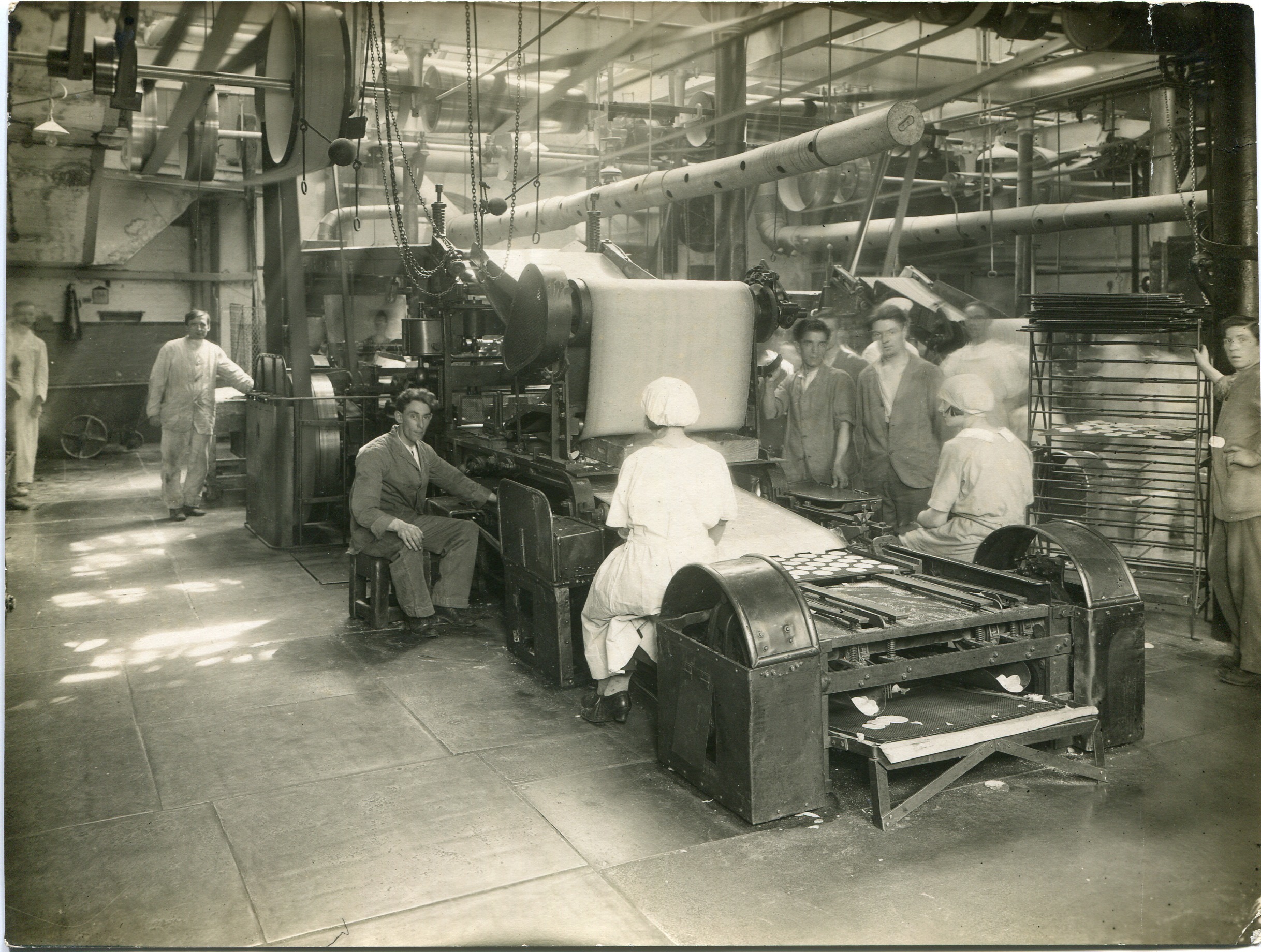
Long before the National Archives moved into the Bishop Street complex, the site was home to one of Dublin’s best‑known industrial landmarks: Jacob’s Biscuit Factory. Established in the mid‑19th century, Jacob’s grew into a vast manufacturing hub, its red‑brick towers and chimneys dominating the south inner city. For generations, the factory shaped the daily life of the neighbourhood — providing employment, drawing workers from nearby streets, and becoming a familiar presence in the lives of thousands of Dublin families.
The factory’s history is intertwined with the history of the city itself. It stood through periods of political upheaval, including the 1916 Rising, when the building was occupied by Volunteers. It witnessed the growth of Dublin’s tenement districts, the rhythms of industrial labour, and the changing fortunes of the families who lived and worked around it. Today, as the home of the National Archives, the building continues to hold the stories of Ireland’s past — not through biscuits and machinery, but through the records that preserve the lives of its people.
One of the richest of those record sets is the 1911 Census, taken on 2 April 1911, exactly 115 years ago. The census is one of the most widely used resources on the National Archives website, offering a detailed snapshot of Irish society at a moment of profound change. It captures households large and small, urban and rural, prosperous and struggling. It records occupations, literacy, family structures and living conditions, revealing the texture of everyday life in extraordinary detail.
For the community around Bishop Street, the 1911 Census opens a window onto the people whose lives were connected to Jacob’s Biscuit Factory — from the Jacob family who led the company to the young workers who lived in the surrounding lanes and streets. The four census returns highlighted here bring that world vividly to life.
The Jacob Family: leadership and legacy
One of the most revealing census returns is that of George Jacob, then 56 years old, who served as Chairman of W. & R. Jacob & Co. In 1911 he was living in Greystones, Co. Wicklow, with his wife Mary and their 29‑year‑old son Harold, who would later take over stewardship of the company.
His form contains an intriguing detail: in the section on religion, George first wrote “Protestant”, then struck it out and replaced it with “not [a] member of any religious denomination.” It is a rare example of someone actively revising their religious identity on the census, and it offers a small but striking insight into his personal convictions at a time when religious affiliation was almost universally declared.
The Jacob household stands in marked contrast to the crowded tenements of the inner city where many of the factory’s workers lived, reflecting the distance, social and geographic, between the company’s leadership and its workforce.
The O’Mara Sisters: working women of the inner city
In contrast, the census return for Sarah and Katie O’Mara, aged 22 and 20, reflects the realities of working‑class life. Living at 26 Marrowbone Lane with their widowed mother, two brothers and two younger sisters, the O’Maras shared a small home in one of Dublin’s most densely populated districts. Both sisters worked in Jacob’s, joining the large female workforce that powered much of the biscuit trade.
Thomas Broe: a child worker in the biscuit trade
The census also records the life of Thomas Broe, who at just 14½ years old was employed as a packer in Jacob’s. His return highlights the presence of child labour in early 20th‑century Dublin, where boys often entered the workforce in their early teens to contribute to household income.
Ellen Byrne: The eldest daughter in a tenement household
One of the most striking stories is that of Ellen Byrne, a 16‑year‑old Jacob’s worker living at 99 Bride Street. She was the eldest daughter in the largest family in the building, with eleven people sharing just two rooms. The house itself held six families and forty people across only nine rooms, a vivid example of the overcrowded tenement conditions that shaped daily life in the south inner city. Ellen’s wages from Jacob’s would have been vital to the household. Her census form reflects the pressures placed on young women in large inner‑city families, balancing work and domestic responsibilities.
A wider workforce: pride, identity and industrial Dublin
Beyond these four examples, the census reveals dozens of other Jacob’s workers across the city — packers, weighers, factory hands, clerks and labourers. While the majority were young women, the factory also employed men in roles such as baking, labouring and clerical work. What stands out is not only the range of jobs, but the way many workers chose to record “Jacobs” explicitly on their census form.
In an era when many people simply wrote “factory worker” or “labourer”, the decision to name Jacob’s suggests something more:
a sense of identity, stability, and perhaps even pride in being associated with one of Dublin’s best‑known employers.
These entries remind us that Jacob’s was not just a workplace — it was a community, a source of income, and for many families, a defining part of daily life.
Together, these census returns reveal the social breadth of the Jacob’s community in 1911. They show the contrast between the Jacob family’s rural comfort and the crowded urban homes of their employees; between the security of ownership and the precariousness of wage labour; between the generations who built the business and the young people whose hands kept it moving.
The 1911 Census is searchable and freely available, offering thousands of stories like these waiting to be uncovered.
These glimpses of 1911 remind us how much of Ireland’s past is held in its records. With the 1926 Census opening on 18 April, we may soon be able to see how the next chapter unfolded for families like these.